

Your advertised rent is a marketing ghost. By the time you reach the signature line, that $2,000 apartment often morphs into a $2,300 monthly burden because of the hidden fees in lease agreement structures that most renters never see coming. It's frustrating to feel nickel-and-dimed by property managers who hide behind complex legal jargon and count on your silence. You're right to feel suspicious when "mandatory technology fees" or "administrative convenience charges" suddenly appear as red flags in the fine print.
You don't have to accept these predatory junk fees as an inevitable cost of living. We'll show you how to identify these traps and use AI-driven tools to audit your contract in under 60 seconds. This guide provides a clear list of common fees to flag, verifies their legality under 2026 state statutes, and gives you the confidence to negotiate with any landlord. You're about to move from a state of confusion to a position of informed control, armed with the data you need to secure a fair deal.
Key Takeaways
- Expose the "unbundling" tactics landlords use to hide the true cost of your apartment behind deceptive base rents.
- Learn to spot predatory hidden fees in lease agreement fine print, including valet trash and administrative "convenience" charges.
- Verify the legality of specific charges against the latest 2026 state-level junk fee bans and federal regulations.
- Master a two-step negotiation strategy to strip non-essential costs from your contract using data-backed templates.
- Leverage AI-driven auditing to generate an instant Lease Health Score and detect risk flags before you sign.
The Rise of Junk Fees: Why Your Rent Isn’t What It Seems
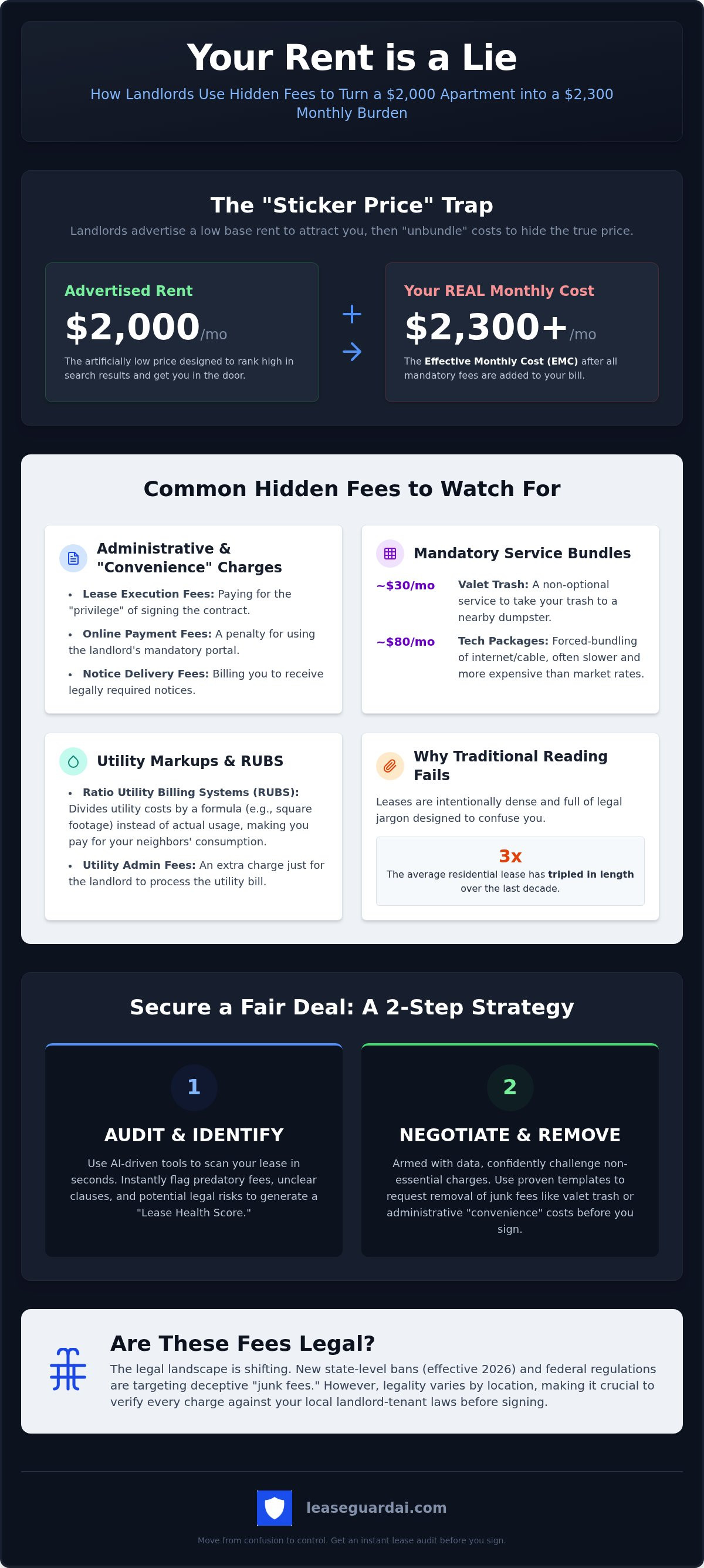
Advertised rent is a lie. It's a sanitized number designed to get you in the door. The reality is often buried in a maze of Junk fee additions that turn a budget-friendly home into a financial trap. These are mandatory, non-rent charges hidden deep within your contract. We call them junk fees because they provide little to no value while siphoning money from your bank account. They're parasitic. They're deceptive. And they're becoming the industry standard.
Property managers have mastered the art of "unbundling." In the past, your rent covered the cost of doing business. Today, landlords strip away maintenance, administrative, and amenity costs. They rebrand them as separate line items. This shift forces you to pay for the landlord's overhead. It's a calculated move to protect their profit margins while keeping base prices artificially low. When you encounter hidden fees in lease agreement clauses, you aren't just paying more. You're paying for services that were once included in the price of admission. The Effective Monthly Cost (EMC) represents the true financial drain on your wallet, contrasting sharply with the low base rent used in marketing materials.
The "Sticker Price" Trap in Modern Leasing
Search algorithms drive this deception. Digital platforms rank listings by base rent. To stay at the top of the results, landlords keep the "sticker price" low. A $1,500 apartment looks better than a $1,700 one. It's simple math for a computer, but a trap for a human. Mandatory fees bridge that gap instantly. You sign up for $1,500, but between valet trash, portal fees, and "community utilities," your monthly commitment hits $1,750. This creates "fee fatigue." Renters stop questioning the charges just to end the exhausting search. Landlords win. Your budget loses.
Why Traditional Lease Reading Fails the Renter
You can't just skim a lease anymore. The average residential contract has tripled in length over the last decade. It's now a dense thicket of legalese designed to overwhelm your common sense. Landlords use complex language to mask simple profit-grabs as "mandatory service requirements." Reading every page manually takes hours. It still leaves you vulnerable to things you don't understand. Your effective rent is the total of all recurring monthly obligations, including every surcharge and service fee. Spotting hidden fees in lease agreement text requires a level of scrutiny that manual reading simply can't provide. You need a way to cut through the noise and see the real cost before you sign.
Common Hidden Fees Buried in the Fine Print
Don't let the legal jargon fool you. These charges aren't just paperwork; they're profit centers designed to drain your bank account month after month. Identifying hidden fees in lease agreement documents requires looking past the bold text and into the "Miscellaneous" or "Additional Charges" sections. Landlords count on you being too tired to read the 40th page. Don't give them that satisfaction. You need to be the watchdog for your own wallet.
Administrative and "Convenience" Charges
Modern property management software has turned "convenience" into a commodity. You'll often find online payment fees that penalize you for not using a specific portal. Some landlords even charge "lease execution fees." This means you're paying them for the privilege of signing their contract. It's an absurd practice. You might also see "notice delivery fees." This allows the landlord to bill you for the cost of delivering a required legal notice to your door. These aren't necessary costs; they're unbundled administrative overhead shifted onto your shoulders.
The Valet Trash and Tech Package "Junk" Trend
The unbundling strategy thrives on mandatory service bundles. Valet trash is the most common offender. You pay $25 to $35 every month for someone to walk your trash to a dumpster you could easily reach yourself. There's rarely an opt-out clause. Tech packages are another growing red flag. Landlords force tenants to pay for proprietary internet or cable services. These are often slower and more expensive than what you could find on the open market. Consumer advocates at the National Consumer Law Center have highlighted How Junk Fees Add to Skyrocketing Rents, noting that these non-optional services make housing increasingly unaffordable.
Utility Markups and RUBS
Watch out for Ratio Utility Billing Systems (RUBS). Instead of a sub-meter measuring your actual usage, RUBS uses a formula based on square footage or occupancy. It's often inaccurate. You end up paying for your neighbor's long showers or a leaking pipe in the common area. Some leases also include "utility administrative fees" just for the landlord to process the bill. Before you commit, use a Free Lease Preview to see if these predatory billing structures are hiding in your contract.
Lease Renewal and Termination Penalties
The costs don't stop when you move in. Hidden fees often trigger when you decide to stay or leave. Look for "lease renewal fees" that charge you hundreds of dollars just to sign an extension. Termination penalties can be even more aggressive. Beyond the standard two-month rent penalty, you might find "re-letting fees" or "marketing charges" meant to cover the landlord's cost of finding your replacement. These hidden fees in lease agreement terms can turn a simple move into a financial disaster. Scrutinize every penalty clause before you pick up the pen. You deserve to know exactly what staying or leaving will cost you.
Are These Fees Legal? Navigating State Landlord-Tenant Laws
Just because you signed the contract doesn't mean every clause is legally enforceable. Landlords often bank on your fear of losing an apartment to slip in terms that violate state statutes. The legal landscape is shifting rapidly in favor of renters. On March 12, 2026, the Federal Trade Commission (FTC) issued an Advance Notice of Proposed Rulemaking to gather public comment on junk fees in the rental housing market. This federal scrutiny follows a massive wave of state-level regulation designed to stop predatory unbundling. You aren't just a tenant; you're a protected consumer.
Many hidden fees in lease agreement documents are actually illegal under local laws. For instance, Vermont has banned rental application fees entirely. New York limits them to $20. In Washington D.C., the maximum application fee for 2026 is capped at $54. If your landlord is charging $100 for a background check in these jurisdictions, they're breaking the law. It's a fundamental rule of leasing: local laws often override what is written in a signed contract. You cannot "waive" your rights by signing a predatory agreement.
State-Level Protections Against Predatory Fees
States like California, Colorado, and Minnesota are leading the charge against hidden costs. As of January 1, 2026, California landlords must allow you to opt out of bundled third-party internet service fees. Colorado now requires landlords to disclose the total price of a rental, including all mandatory fees, in property listings. These laws are designed to prevent the "sticker price" trap. Consumer advocacy groups like the National Consumer Law Center provide detailed reports on How States Can Fight Rental Housing Junk Fees, helping renters identify which charges are legitimate and which are profit-grabs. If a fee feels excessive, it might be legally "unconscionable" and unenforceable in court.
Late Fees and Legal Limits
Late fees are a common source of friction, but they have strict legal boundaries. In 2026, the most common late fee is 5% of the monthly rent. For a $1,500 apartment, that's $75. While some states don't have hard caps, courts usually apply a "reasonableness" standard. Fees exceeding 10% are frequently flagged as predatory penalties. Many jurisdictions also mandate a grace period, typically three to five days, before a landlord can legally assess a charge. You don't need to be a lawyer to find these rules. Our State Statute Database Access tool instantly pulls the relevant citations for your city and state, giving you the hard data needed to challenge an illegal charge. Stop guessing and start verifying.
How to Negotiate and Remove Predatory Lease Fees
Negotiation isn't a conflict. It's a correction. Landlords often include hidden fees in lease agreement drafts because they expect tenants to be too intimidated to speak up. You have the leverage. Property managers hate vacancies more than they love a $30 trash fee. To win, you must swap emotion for evidence. Follow this methodical framework to strip away the junk and protect your budget.
Start by sorting every charge into "Essential" and "Non-Essential" categories. Essential fees cover actual costs like water or electricity. Non-essential fees are profit-grabs like "lease prep" or "portal access." Once identified, compare these numbers to local market standards. If the building across the street doesn't charge for valet trash, you have a data point. Draft a professional "Fee Challenge" email. State your findings clearly. Request the removal of service bundles you don't need. If they agree, ensure the changes are documented in a signed addendum before you touch the main contract. Verbal promises are worthless in housing court.
The Renter’s Negotiation Script
Precision matters in your delivery. Don't just ask for a discount. Use a script that highlights your value as a tenant. Try this: "I’ve reviewed the tech package requirement. As of January 1, 2026, I’m aware of my right to opt out of bundled internet services. I’d like to move forward with my own provider." This shows you're informed. If they push back on administrative fees, cite the "Fair Market Value." Point out that these costs are typically landlord overhead. Know your "Walk Away" point. If the hidden fees in lease agreement terms push your total cost beyond your limit, leave. Over half of renters now apply to multiple properties. You have options.
Leveraging State Statutes in Your Conversation
Statutes are your ultimate shield. When you cite a specific law, the conversation changes instantly. You're no longer a "difficult" tenant; you're a legal liability for a landlord who breaks the rules. If you're in Colorado, remind them that property listings must disclose all mandatory fees by law. In California, mention your right to opt out of third-party bundles. This professional assertion of your rights often turns a "Red Flag" into a negotiation win. Landlords would rather drop a fee than risk a regulatory complaint. To make this process seamless, download our Negotiation Templates to get the exact phrasing you need to challenge predatory charges with confidence.
Audit Your Lease Instantly with LeaseGuard AI
Manual lease review is a relic of the past. Squinting at fifty pages of legal jargon for hours is no longer necessary, and it's certainly not effective. Landlords count on human error and "fee fatigue" to slip predatory terms past you. LeaseGuard AI changes the power dynamic. Our proprietary technology scans your entire contract in under 60 seconds, identifying hidden fees in lease agreement clauses that would take a human hours to find. We pull back the curtain on unbundled costs, giving you an immediate, high-level summary of exactly what you're signing.
The core of our analysis is the Lease Health Score. This data-driven risk assessment provides an instant grade for your contract. A high score indicates a transparent, fair agreement. A low score serves as a critical red flag, highlighting unlimited risk flags that require your immediate attention. You'll see exactly where the landlord has unbundled standard operating costs and rebranded them as "tenant responsibilities." It's a digital sanity check that replaces confusion with informed control.
Consider the math of modern renting. A $19.99 Pro Lease Analysis Report is the ultimate insurance policy. It's a small, high-ROI investment that prevents a $2,000 mistake over the course of a year-long lease. When you identify just one $150 "lease prep fee" or a $30 monthly valet trash charge you didn't agree to, the tool pays for itself instantly. You aren't just buying a report; you're buying the leverage needed to protect your bank account from parasitic charges.
From Confusion to Clarity in 60 Seconds
We adopt a watchdog mentality. While traditional legal services are slow and prohibitively expensive, our AI delivers efficiency and modern speed. The system flags predatory clauses with surgical precision. Once the scan is complete, you receive a full Pro Lease Analysis Report in PDF format. This isn't just for your records. It's a professional briefing you can share directly with your property manager to justify your negotiation demands. It turns "I think this is unfair" into "This fee is documented as a high-risk flag."
Your Renter Advocacy Toolkit
Detection is only the first step. To win the negotiation, you need backup. Our platform provides State Statute Database Access, allowing you to cite specific 2026 laws that protect you in all 50 states. If a fee violates a local cap, you'll have the citation ready. We also provide "Ready-to-Send" Negotiation Templates. These are professionally drafted email frameworks designed to challenge fees without damaging your relationship with the landlord. You have the data. You have the law. Now, you have the voice to use them. Audit your lease for hidden fees now and take back control of your housing costs.
Take Control of Your Rental Future
You've seen how the property management industry uses unbundling to hide the true cost of housing. Advertised rent is just the starting point. From valet trash to predatory tech packages, these charges add up to thousands of dollars over a year. Identifying hidden fees in lease agreement documents is your first line of defense against being nickel-and-dimed. You now have the knowledge to spot illegal application caps and excessive late fees before they hit your bank account.
Knowledge is power, but speed is your advantage. Don't waste hours manually checking statutes when you can have a digital ally do the heavy lifting. Our AI flags over 50 types of predatory clauses and provides an instant Lease Health Score. It even includes state-specific legal citations to back up your negotiation. You deserve a fair deal and a home that doesn't drain your savings through the fine print.
Check your lease for hidden fees in 60 seconds. Take the lead, challenge the junk, and sign your next contract with absolute confidence.
Frequently Asked Questions
Can a landlord add new fees after I have already signed the lease?
No. A lease is a legally binding contract that locks in your financial obligations for the duration of the term. Landlords cannot unilaterally add new hidden fees in lease agreement clauses once the document is executed. Any new charges would require a signed addendum from both parties. Most landlords wait until your lease renewal to introduce new "service bundles" or administrative surcharges.
What are the most common "junk fees" in modern apartment leases?
The most frequent offenders in 2026 include valet trash, online portal "convenience" fees, and mandatory tech packages for internet or smart home features. You will also see administrative lease preparation charges and "community utility" surcharges. These are unbundled costs that landlords formerly included in the base rent but now list as separate profit centers to keep advertised prices low.
Is a "valet trash" fee mandatory if I don’t want the service?
It is usually mandatory if it is written into the contract you sign. Corporate landlords often treat these as non-negotiable service bundles. However, transparency laws are changing. In states like Colorado, effective January 1, 2026, landlords must disclose all mandatory fees in the initial property listing. If it wasn't disclosed upfront, you have significant leverage to demand its removal during negotiation.
How much is a "reasonable" late fee in most states?
A late fee of 5% of the monthly rent is the standard for "reasonableness" in 2026. On a $1,500 apartment, that amounts to a $75 charge. While some states don't have hard caps, courts often flag fees exceeding 10% as predatory penalties. Most jurisdictions also require a grace period of three to five days before any fee can be legally assessed against you.
Are administrative fees for lease preparation legal?
They are technically legal in many states unless specifically capped by local statutes. For example, Illinois will begin capping move-in fees at 20% of the first month's rent starting January 1, 2027. Despite their legality, these are pure junk fees. You are paying the landlord to perform their own administrative duties. You should always challenge these fees as a condition of signing.
Can I negotiate the removal of a "tech package" or "smart home" fee?
Yes, and in some places, it is your legal right. As of January 1, 2026, California landlords must allow tenants to opt out of bundled third-party internet service fees. In other states, you should use market comparisons to show that these proprietary services are overpriced or unnecessary. Assert your preference for your own providers early in the conversation to avoid these monthly drains.
What happens if I sign a lease that contains an illegal fee?
An illegal clause is generally unenforceable even if your signature is on the page. State landlord-tenant laws almost always override private contracts. If you discover a charge violates a state cap, such as New York’s $20 application fee limit, the landlord cannot legally collect it. Signing the lease does not mean you have waived your rights to protection under state or federal consumer laws.
How does LeaseGuard AI detect fees that aren’t explicitly labeled?
Our technology looks beyond simple keywords. It analyzes the structure of "Additional Charges," "Utility Addendums," and "Rules and Regulations" to find hidden fees in lease agreement fine print. The AI identifies unbundled costs masked as "mandatory service requirements" or "administrative convenience." It then contextualizes these findings with our 50-state statute database to give you an instant Lease Health Score.

