

Your lease is not a fixed law; it's a negotiation, but only if you know where the landmines are buried. Most renters sign their contracts with a sense of dread, fearing that hidden fees or predatory terms are lurking in the fine print. You probably feel like the landlord holds all the cards, especially when state landlord tenant laws seem like a tangled web of conflicting rules. It's a common frustration. You want a safe home without being exploited by junk fees or illegal security deposit caps.
This 2026 guide changes the power dynamic. You will learn to master the legal landscape of your specific state and gain the exact skills needed to detect illegal clauses before you ever pick up a pen. LeaseGuard AI is pulling back the curtain on new 2026 protections, covering everything from comprehensive rent disclosure rules to mandatory appliance requirements. By the end of this article, you'll have the clarity to spot red flags and the confidence to negotiate terms that actually protect your rights. It's time to stop guessing and start signing with total certainty.
Key Takeaways
- Map the legal hierarchy between federal and state mandates to ensure local protections are never bypassed.
- Secure your finances by identifying the specific state landlord tenant laws that cap security deposits and prohibit junk fees.
- Detect "red flag" clauses like illegal liability waivers that remain unenforceable despite your signature.
- Execute a rapid "sanity check" on your lease to confirm non-waivable rights to habitability and privacy.
- Deploy data-driven tools to scan for compliance violations and access professional negotiation templates in seconds.
Understanding the Patchwork of US Landlord-Tenant Statutes
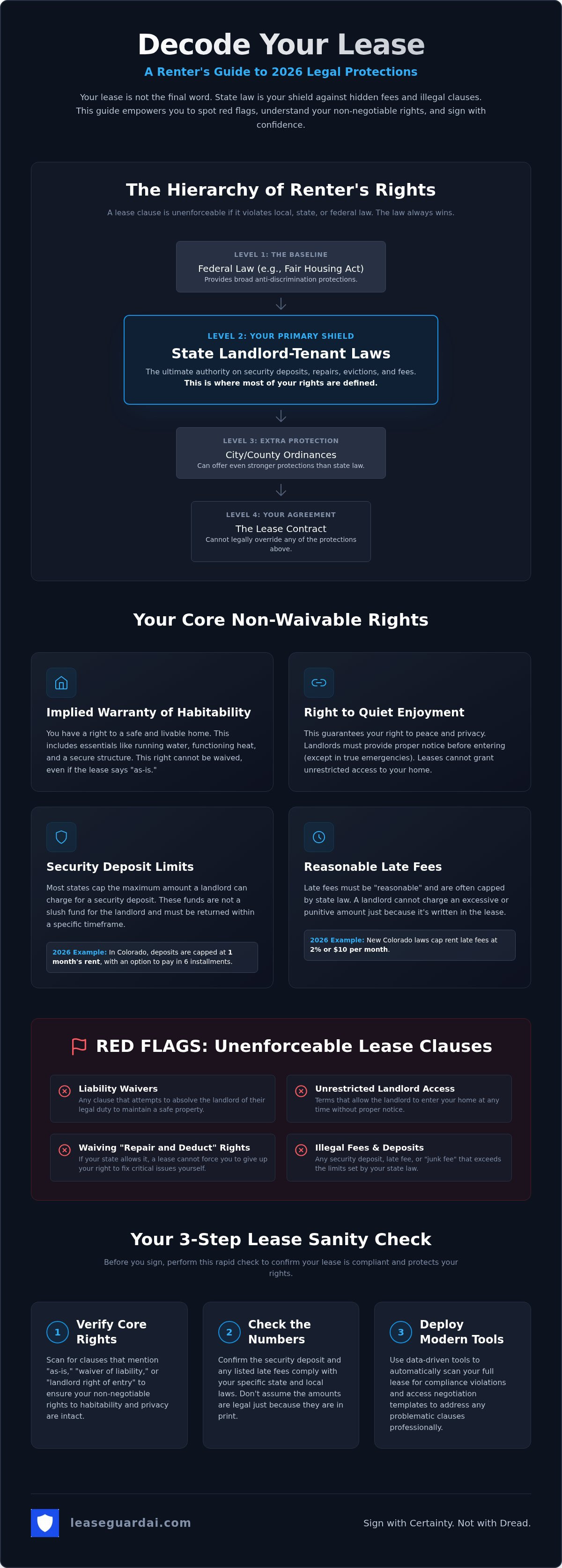
Don't let a thick stack of lease paperwork intimidate you. Your lease is a contract, but it isn't the final word on your rights. While a landlord might try to bury predatory terms in the fine print, state landlord tenant laws serve as the ultimate authority. These statutes act as a protective shield. They ensure that no matter what "house rules" a landlord invents, they cannot bypass the legal standards set by your state legislature. If a lease clause conflicts with state law, the law wins every time. The clause becomes unenforceable garbage.
Most renters assume federal law covers their entire experience. It doesn't. A solid foundation in understanding landlord-tenant law starts with recognizing that your state capital, not Washington D.C., usually decides your fate. Your state dictates how quickly you get your security deposit back. It defines how much notice you receive before an eviction. Federal rules provide the baseline, but state statutes provide the teeth.
One of the most critical protections is the "Implied Warranty of Habitability." This is a non-negotiable legal doctrine. It means your landlord must provide a home that is fit for human life. Think running water, functioning heat, and a roof that doesn't leak. If a lease says "tenant accepts property as-is including broken plumbing," that clause is illegal. You cannot "contract out" of basic safety. State protections are mandatory and non-waivable.
Federal vs. State Jurisdiction
The Federal Fair Housing Act sets the baseline for anti-discrimination. It protects you from bias based on race, religion, or disability. However, the granular details of your daily life are governed by state mandates. Your state dictates the maximum security deposit. It sets the strict timeline for essential repairs. In "Home Rule" states, your city might even add extra layers of protection. Check your local ordinances. They often provide even stronger defenses than state landlord tenant laws alone.
The Quiet Enjoyment Principle
You aren't just paying for four walls. You are paying for "Quiet Enjoyment." This isn't about noise levels; it's about your right to peace, privacy, and exclusive use of the space. Landlords often violate this by entering without notice or using "emergency" as a fake excuse for routine inspections. In 2026, the right to Quiet Enjoyment remains a non-waivable protection in every state, meaning no lease can legally grant a landlord unrestricted access to your home.
Key Legal Protections Every Renter Must Know
Your signature on a lease doesn't give a landlord permission to ignore the law. Many renters believe that once they sign a contract, they've signed away their rights. This is a dangerous myth. State landlord tenant laws create a mandatory floor of protection that no lease can fall below. If your landlord includes a clause that violates these statutes, that clause is legally void. You need to know exactly which lines a landlord cannot cross.
Security deposit caps are your first line of defense. Landlords often treat these deposits like a slush fund, but 2026 regulations are tightening the leash. For example, as of January 1st, 2026, Colorado caps security deposits at exactly one month's rent. Tenants there also have the legal right to pay that deposit in six monthly installments. If you aren't sure about your local limits, checking state-specific landlord-tenant statutes is the fastest way to verify if your landlord is overreaching. If you want to know if your specific contract is compliant, a quick Free Lease Preview can flag illegal deposit terms in seconds.
Late fees are another area where landlords frequently overstep. A fee isn't legal just because it's in the contract. It must be "reasonable." In states like Colorado, new 2026 laws prohibit late fees on non-rent charges and cap rent late fees at 2% or $10 per month. When a fee becomes "unconscionable" or exceeds these statutory limits, you have the right to refuse payment of that specific charge. Always verify the math before you pay.
Repair and deduct rights provide a "self-help" remedy when a landlord ignores maintenance. If a critical issue like a broken heater or a leaking roof isn't fixed promptly, many states allow you to hire a professional and subtract the cost from your next rent check. Georgia's 2026 laws, for instance, put a heavy emphasis on prompt habitability repairs for heating and cooling. However, you must follow strict notice requirements before taking this step. Never stop paying rent without documenting the process first.
Security Deposit Deadlines and Limits
The clock starts ticking the moment you hand over your keys. Most states require the return of your deposit within 14 to 30 days. Landlords cannot retain your money for "normal wear and tear," such as faded paint or minor carpet aging. They must provide an itemized list of deductions for actual damage. If they miss the statutory deadline, many state landlord tenant laws require them to return the full amount regardless of damage.
Access and Privacy Rights
Your home is your sanctuary, not a landlord's showroom. Most states mandate a 24 to 48-hour notice before a landlord can enter for non-emergencies. If your lease claims the landlord can enter "at any time" for inspections, that clause is likely illegal. California's 2026 updates continue to strictly limit entry to specific business hours. Unless there is an active flood or fire, you have the right to say no to unannounced visits.
When State Law Overrides Your Lease: Unenforceable Clauses
Your signature on a lease isn't a magic wand that makes illegal terms valid. Landlords often use "dummy" clauses to intimidate tenants into silence. They hope you'll assume that because you signed the document, you've waived your rights. This is fundamentally false. Under state landlord tenant laws, any lease provision that contradicts a statutory right is void as a matter of public policy. If it's illegal, it's dead on arrival. You don't need a lawyer to tell you that a contract cannot override the law.
Predatory clauses like "As-Is" rental agreements are classic examples of this deception. In states like Georgia, 2026 laws now mandate that properties must be safe and functional regardless of what the lease says. You cannot waive your right to a working stove, hot water, or a functional electrical system. Similarly, indemnification traps try to make you responsible for the landlord’s own negligence. If a stairwell collapses because of rot, a "Hold Harmless" clause won't save the landlord from liability in most jurisdictions. They have a duty of care that cannot be signed away.
When these conflicts escalate to the threat of removal, the LSC Eviction Laws Database provides a clear view of how state statutes override lease-based eviction threats. Understanding these boundaries prevents you from being bullied by unenforceable language. Another common trap is the automatic renewal clause. Many states now require landlords to provide a separate, conspicuous disclosure before a lease can legally renew itself. If they skip the notice, the renewal might not be binding, no matter what the original contract says.
The Liability Shield Scam
Landlords love "Hold Harmless" clauses. They want you to believe that if a guest trips on a loose floorboard, it's your problem. It isn't. Most states prohibit landlords from waiving their basic duty of care. Predatory language regarding guest injuries or property damage often fails in court. The landlord is responsible for the structural integrity of the building. You are responsible for your own behavior, not their failed maintenance.
Illegal Fee Structures
Watch out for "administrative" fees for basic maintenance or property taxes. In Colorado’s 2026 update, HB25-1090, landlords are strictly prohibited from separating fees to make the rent appear lower. They cannot charge for payment processing if a free option isn't available. These are hidden profit centers, not legitimate costs. Our Pro Lease Analysis Report uses state landlord tenant laws to flag these violations in under 60 seconds. It gives you the exact citations needed to push back and demand a clean contract.
How to Verify Your Lease Against State Statutes in Seconds
Traditional lease review is a relic of the past. You don't need to spend three hours in a law library or pay a retainer to know if you're being exploited. Verification is now a matter of data, not just intuition. By following a systematic process, you can strip away the landlord's advantage and see the contract for what it truly is. Your goal is to align every sentence in that document with current state landlord tenant laws. It’s about moving from a state of intimidation to a state of informed control.
Start by identifying your state’s specific "Renters Bill of Rights." This isn't always a single document. It’s often a collection of statutes that define your fundamental protections. Next, scan your lease for non-waivable rights. If you see language attempting to limit the landlord’s duty to provide heat, water, or basic safety, stop right there. Step three involves using technology to bridge the gap. Legalese is designed to be confusing. Digital tools translate these complex sentences into plain English while checking them against current statutes. Finally, generate a risk score to prioritize your negotiation. You shouldn't waste energy on minor typos. Focus your leverage on the high-risk violations that threaten your security or your wallet.
Manual Research vs. AI Analysis
Manual research is a trap. It takes hours of cross-referencing to find a single relevant statute. Even then, you might misinterpret the language. Studies show that manual reading misses approximately 30% of predatory "fine print" clauses because they are intentionally buried in dense paragraphs. Traditional legal reviews are slow and expensive. A digital Pro Lease Analysis Report eliminates this risk. It provides a comprehensive audit of your contract against state landlord tenant laws in under 60 seconds. You get the speed of a computer with the precision of a legal database. No more guessing.
Understanding Your Lease Health Score
A Lease Health Score quantifies your legal safety. It turns a "gut feeling" into a clear, actionable data point. Red flags represent dealbreakers. These are direct violations of the law, such as illegal security deposit caps or waivers of habitability. Yellow flags are points of concern. These might include vague language about repair timelines or restrictive guest policies. This score moves you from a position of uncertainty to a position of power. You no longer have to hope the landlord is being honest. You will have the exact citations needed to prove they aren't.
Take the guesswork out of your next move. Get a Pro Lease Analysis Report and see your health score instantly.
LeaseGuard AI: Your 24/7 Watchdog for Legal Compliance
Stop playing defense. Landlords often have legal teams or expensive software to protect their interests; you need an equalizer. LeaseGuard AI functions as your digital ally, stripping away the complexity of your contract to reveal the truth. Our Pro Lease Analysis Report delivers a comprehensive audit in under 60 seconds. It doesn't just tell you something is "unfair." It proves it by cross-referencing your specific contract against the most current state landlord tenant laws. You're no longer guessing; you're verifying.
Hidden fees are the silent killers of a rental budget. From illegal payment processing charges to "administrative" maintenance fees that violate 2026 transparency laws, these costs add up to thousands over a lease term. Investing $19.99 in a Pro report is a small price for total peace of mind. It's a strategic move that saves you from thousands in future legal fees or lost security deposits. We pull back the curtain on predatory language so you can sign with grounded confidence.
Instant Detection of Predatory Terms
Our AI scrutinizes every sentence for conflicts with your specific state statutes. It flags non-waivable rights that a landlord might try to bypass, such as mandatory appliance maintenance or installment options for deposits. You'll receive a full PDF report that serves as a permanent record for your files. The Pro report provides specific legal citations for every flag, giving you the exact statute number to reference when you challenge a clause. This data-driven precision ensures your scrutiny is backed by the law.
Negotiating Like a Pro
Identifying an illegal clause is only the first step. You need to know how to speak up without losing the apartment in a competitive market. We provide professional Negotiation Templates and email scripts designed to challenge unfair terms firmly but professionally. These scripts use a "watchdog" logic to show the landlord you're an informed tenant who understands their rights. You can stay firm on your legal protections while keeping the conversation productive. Don't leave your housing security to chance. Get your Free Lease Preview and spot the red flags today!
Secure Your Rights Before You Sign
Your lease shouldn't be a source of anxiety. You've learned that state landlord tenant laws are your ultimate defense against predatory terms. You now know that illegal clauses are void. Your signature doesn't change the law. You have the steps to verify habitability and privacy rights. Don't let a landlord's complex contract dictate your peace of mind. You have the power to challenge unfair fees and demand transparency. It's about shifting the balance of power back into your hands.
Knowledge is only half the battle. Action is what secures your rights. Analyze your lease for state law compliance in 60 seconds to see exactly where you stand. Our Pro report includes a detailed Lease Health Score and state-specific legal citations. We handle the predatory clause detection so you don't have to. You're ready to sign with total certainty. Your housing security starts with being informed. Take the final step toward a fair rental agreement today.
Frequently Asked Questions
Is a lease still valid if it contains an illegal clause?
Yes, the lease usually remains valid, but the illegal clause itself is void and unenforceable. Courts typically "sever" the illegal part while keeping the rest of the contract in place. You aren't bound by terms that violate state landlord tenant laws, even if you signed the document. The landlord cannot use a void clause to evict you or withhold your deposit.
How much can a landlord legally charge for a security deposit in my state?
Limits vary significantly by state, often ranging from one to two months' rent. For instance, as of January 1, 2026, Colorado caps deposits at one month's rent and requires landlords to offer a six month installment plan. California's 2026 reforms also mandate electronic returns if requested. Always check your specific state statute to ensure your landlord isn't overcharging during the move-in process.
Can my landlord enter my apartment without notice in an emergency?
Yes, landlords have the legal right to enter without notice if there is a genuine emergency like a fire, gas leak, or active flood. For all non-emergency situations, most states require a 24 to 48 hour written notice. If your landlord enters for routine inspections without warning, they are likely violating your right to quiet enjoyment and privacy.
What are the most common unenforceable clauses in residential leases?
"As-is" clauses regarding habitability and total liability waivers are the most frequent offenders. Landlords often try to make you responsible for structural repairs or guest injuries. These terms are legally void because they attempt to bypass mandatory safety standards set by state landlord tenant laws. You cannot sign away your right to a safe, functional home.
How do I know if my landlord’s late fee is legal?
A legal late fee must be "reasonable" and clearly disclosed in your contract. Many states now set hard caps on these charges. In Colorado, 2026 laws limit late fees to 2% of the rent or $10 per month. If your fee is higher or applies to non-rent charges like utilities, it's likely unconscionable and unenforceable in a housing court.
Can I break my lease if the landlord violates state habitability laws?
Yes, but you must follow a strict legal process to avoid being sued for unpaid rent. You must provide written notice of the defect and allow a reasonable time for repairs. If the home remains unsafe, such as having no heat or running water, you can often terminate the lease under the doctrine of constructive eviction.
Does LeaseGuard AI provide actual legal representation?
No, we do not provide legal representation, commercial lease reviews, or lease drafting services. We are a tech-driven advocate providing data analysis and compliance tools. Our platform flags predatory terms and provides citations to help you understand your position. We are not a law firm and cannot represent you in court or provide legal advice.
What is the difference between a Free Lease Preview and a Pro Report?
The Free Lease Preview provides a high-level scan to spot immediate, high-risk red flags. The Pro Lease Analysis Report offers a deep dive into the entire contract. It includes your full Lease Health Score, specific legal citations for every violation found, and professional negotiation templates to help you challenge unfair terms with confidence.

